|
Culross is situated on the North shore of the Firth of Forth. You can find information about Culross at a number of websites, this is a visitors guide to Culross while this is the official National Trust for Scotland site about Culross, this site has some nice photographs of Culross and this is the site to visit for historical information.
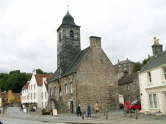
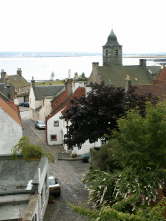
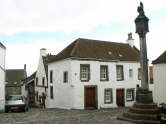
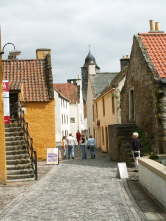
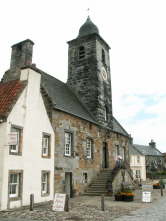
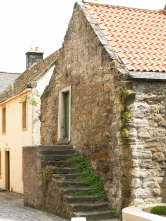
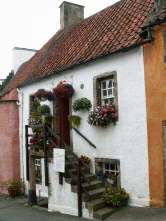
Though its outlook across oily mud-flats to a generating station is hardly prepossessing, the little Royal Burgh itself looks like a set for an historical film, and is often used as such. Many of the buildings, dating from the 17th century and earlier, have been restored by the National Trust for Scotland, and the Electricity Board has concealed its substation within an old town house. Once Culross was a well-known port, trading with the Low Countries; its ships brought back the red pantiles that cover the town's roofs, and some architectural ideas too, to judge from the Dutch flavour of many of the houses.
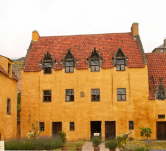
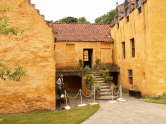
As early as 1575, Culross coal was being mined at 240 ft, thanks to the ingenious methods of ventilation and drainage devised by the laird, Sir George Bruce. The magnificent Culross Palace is no royal residence - it was Sir George's home and office combined, built between 1597 and 1611 around a fine courtyard with a terraced garden to the north. Walls and ceilings in its main rooms are decorated with superbly luminous paintings in tempera - a technique in which raw egg or animal glue is used when mixing pigments.
In one room Sir George entertained business partners; and another, which has a ceiling 9 ft thick, was his strongroom. The palace is open all the year.
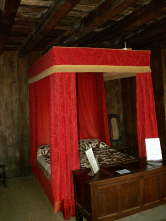
A bedroom was specially decorated for James VI (James I of England), who visited Culross in 1617. Sir George proudly showed the king his Moat Pit, one of the wonders of 17th-century coal-mining. They finished their underground walk by climbing up a stairway to an artificial island in the Forth, which acted both as a ventilation shaft and mooring place for colliers. The king was notoriously suspicious, and when he emerged to find himself surrounded by water he immediately suspected - until reassured -that he was being kidnapped.
It is open to the public in the summer, as is the 17th-century Town House, and The Study, so called from the small, quiet room at the top of its tower, with its fine painted ceiling. All through the burgh there are odd, unexpected delights, such as the House with the Evil Eye (so called because of its oddly positioned windows) and the old shops and cottages bearing the insignia and inscriptions of the trades that were once practised in them.
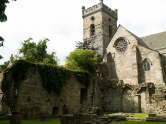
The Cistercians founded Culross Abbey in 1217, and became the first Scottish coalminers not long after. Part of the Abbey is now the parish church. Inside is the tomb of Sir George and Lady Bruce, with their effigies recumbent on top and statues of their children in front. In another tomb lie Sir Robert and Lady Preston of Valleyfield, 1½ miles east. Sir Robert was involved in coal-mining in the early 19th century; the ruins of his workings can be seen on Preston Island - now part of the mainland.
In the churchyard are several gravestones with the device of a hammer topped by a crown. This was the royal warrant mark of the Hammermen of Culross, who had a lucrative monopoly throughout Scotland in the manufacture of iron baking girdles or griddles.
Just outside the town there are the remains of a 16th-century chapel, traditionally built upon the site of the birthplace of St Kentigern who, better known by his nickname of Mungo (Latin-Welsh for 'dear friend'), became the patron saint of Glasgow.
At the western end of Culross, Dunimarle Castle houses a collection of paintings, glass, books and Empire furniture, some of which belonged to Napoleon.
|